Employment Termination in Armenia: Risks and Garden Leave

Shushanik Stepanyan
Head of Employment Law Practice, Concern Dialog
4 min read
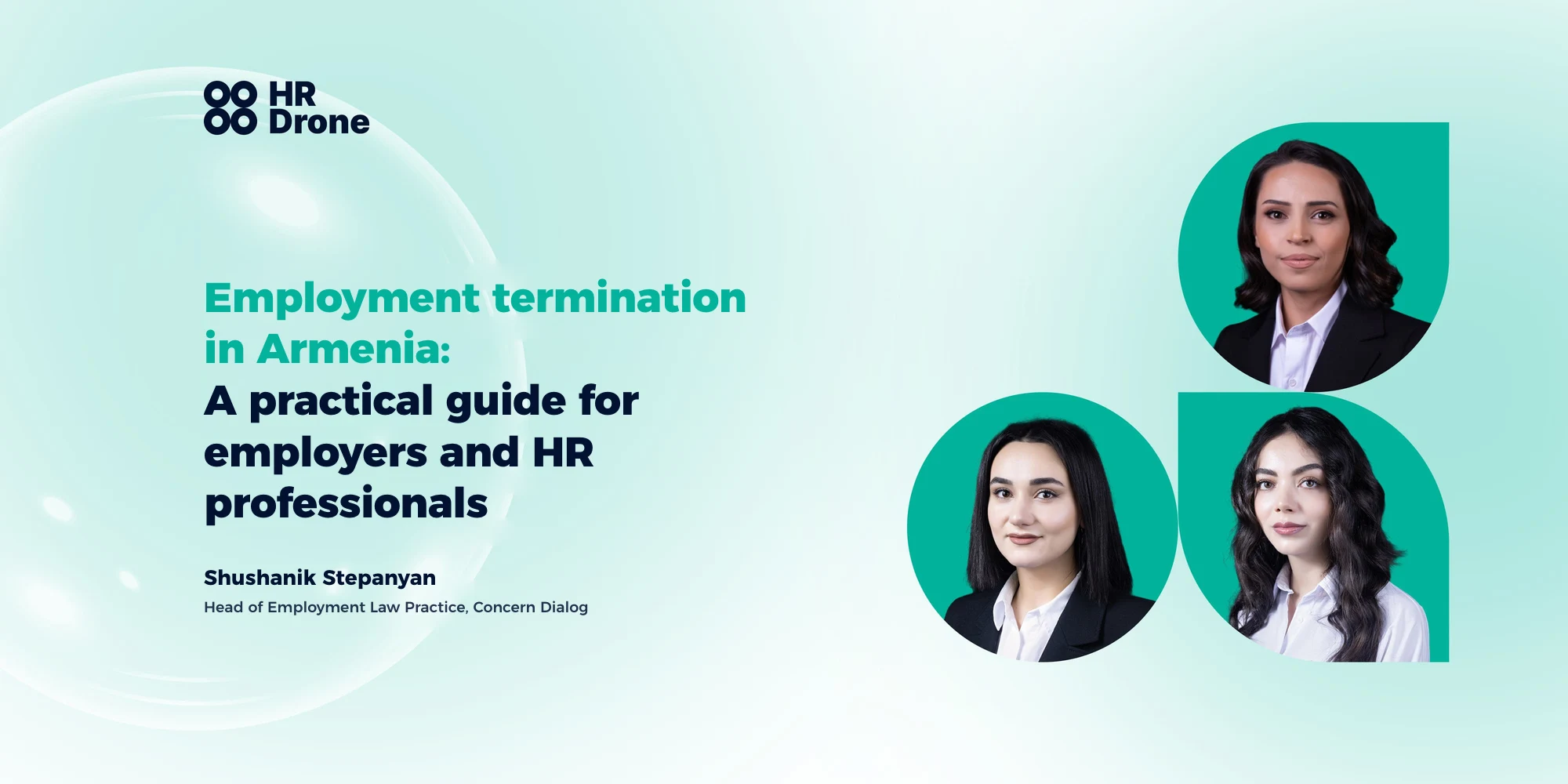
For companies operating in Armenia or planning to expand there, a deep understanding of local labor law, including the rules on employment termination in Armenia, is a key practical task for keeping the business protected.
To give employers and HR professionals strategic support on this, the Concern Dialog law firm has partnered with the prestigious Legal 500 to prepare the official guide "Armenia: Employment and Labour Law Country Comparative Guide 2026".
The guide was prepared by Concern Dialog's Head of Employment Law Practice Shushanik Stepanyan, senior lawyer Ani Telunts and lawyer Hayarpi Mkrtchyan. Below are the key topics the guide covers, which every employer should pay attention to.
1. When Is Employment Termination in Armenia Lawful?
Unlike the United States, for example, where the "at-will employment" model is standard (the employer can dismiss an employee at its own discretion, at any time), in Armenia termination of the employment contract is allowed only on the grounds exhaustively listed in the Labor Code of the Republic of Armenia (ՀՀ աշխատանքային օրենսգիրք).
Employers are often surprised to learn that the conduct they describe, however unacceptable or serious a breach it is considered inside the company, is not in itself a lawful reason for dismissal unless the Labor Code directly provides for it.
Important. Even when a lawful ground exists, if the dismissal order does not clearly and specifically state the factual and legal grounds for dismissal (what the employee did and the relevant articles of the law), a court may declare the order unlawful, creating serious financial risks for the employer.
2. Change of Ownership or M&A: Is It Grounds for Termination of Employment?
When a company is reorganized or changes owners, the new management often wants to replace the whole team. A change of owner or the reorganization of the company is not in itself grounds for terminating employment relations, unless it has led to an actual reduction in positions or in the number of employees.
3. Garden Leave: Can It Be Used in Armenia?
Garden leave is a common practice internationally: during the notice period, the employer bars a departing employee from coming to work, contacting clients or using internal systems, in order to protect business secrets. Throughout this period, the employee keeps their position and receives their full salary.
Although the concept is not explicitly defined in Armenian law, it can be applied in practice and does not contradict the law, provided the employer fully respects the employee's right to pay.
4. AI and Whistleblower Protection in 2026
The guide also addresses current trends:
- The risks of AI in HR decisions. Armenia's Labor Code sets a general principle that, when making decisions about an employee (including hiring or dismissal), the employer cannot rely solely on automated processing or data from electronic systems. Without human involvement, such decisions carry significant legal risks.
- Whistleblower protection. The law strictly prohibits any "detrimental action" (dismissal, demotion or a pay cut) against employees who have made statements in defense of the public interest (whistleblowing).
5. The Financial Consequences of Unlawful Dismissal
If a court rules a dismissal unlawful, the employer faces a heavy financial burden:
- The employer must pay the employee's average salary for the entire period of forced absence from work.
- If reinstatement is impossible (for example, the position no longer exists), the court orders the employer to pay additional compensation of 1 to 12 times the employee's average monthly salary.
How to Mitigate the Risks: Concern Dialog's Advice
To avoid lengthy court proceedings, it is advisable to introduce clear internal policies and a well-regulated, thoroughly documented disciplinary system. This lets the employer define in advance the range of conduct the company finds unacceptable, and employees who know these rules will avoid such breaches. At the same time, employees who break the rules can be held disciplinarily liable in a lawful way.
Since Armenian law requires an employee to have at least two disciplinary sanctions that have neither expired nor been lifted before they can be dismissed for a disciplinary breach, recording every breach correctly and on time becomes the main guarantee of the business's legal security.
Contact Us
You can read the full announcement of the guide's publication on Concern Dialog's LinkedIn page.
For legal advice specific to your company's employment relations in Armenia, contact the Concern Dialog team at info@dialog.am or through the company's LinkedIn page.
See also our articles on the consequences of unfair dismissal and the rules on probation period pay. To fill a vacant position quickly, use the HR Drone for companies page.
This article is for informational purposes only; it does not constitute legal advice and cannot replace it.